
How to Keep Customer Inquiries From Getting Lost Between Your Inbox and a Quote
Published
A practical guide to assigning inquiry ownership, distinguishing drafts from sent replies, preserving human review, and keeping a clear next action.
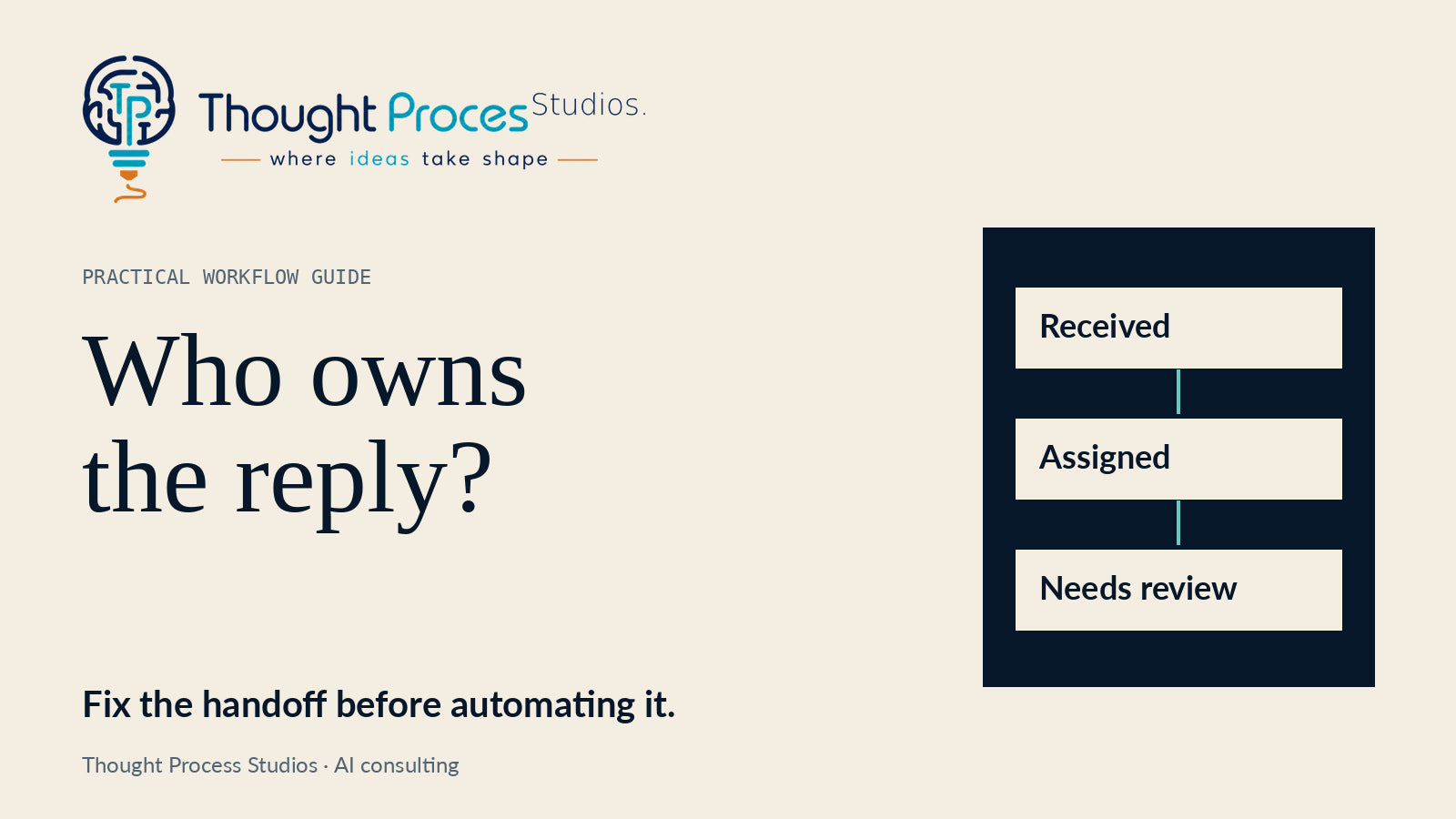
A quote request arrives. Someone reads it. Someone else is expected to reply. The missing step is not necessarily another tool: it may be a clear agreement about who owns the next action.
Before automating inquiry follow-up, sketch the path from the first message to a reviewed response. The example below is illustrative, not a customer case study or a claim about measured results.
Give each inquiry an owner and a backup.
A shared inbox can be a useful entry point, but specify who checks new requests and who takes over when that person is unavailable. Record the assignment where the team already manages the work. A forwarded message is not evidence that someone accepted responsibility.
Distinguish received, drafted and sent.
These are different states. An acknowledgment confirms receipt; it does not answer a question, approve a price, or promise a delivery date. A prepared response still needs any required review and a confirmed send. Choose a small set of states that reflect the way your business actually works, including waiting on the customer and needs owner review.
Keep the next action visible.
For each inquiry, record a reference to the original message, when it arrived, the responsible person, its current state, the next action and the internal review time. Store only information needed for the work in systems approved for it. Do not copy confidential attachments into a new AI tool merely to make the workflow look complete.
Test one simple handoff.
An illustrative path is: inquiry received → quoting owner assigned → necessary details checked → response drafted → human review → response sent. If a project description is incomplete, the next action may be a request for clarification, not a quote. If the request is outside your usual scope, route it to the person authorized to decide rather than inventing a standard answer.
Make the exception path explicit.
Decide what happens when the assigned person is away, a connection fails, or a customer changes the request. Keep a visible fallback queue and a manual way to continue. Check the original record before retrying a failed automated action so the customer does not receive duplicate replies. Set review times around your real capacity; an internal target is not a customer-facing promise.
Measure the handoff before expanding it.
Review actual examples for unassigned requests, duplicated responses and the time from receipt to a meaningful reply. Separate an automated acknowledgment from a reviewed answer. Then track which genuine inquiries progress to consultations, proposals and accepted work. A request is not a sale, and a test appointment is not a customer lead.
Start with one inquiry source and a reversible change. A checklist, a clearer assignment rule, or a connection between existing tools may be enough for the first improvement. Add AI where it serves a defined job, while retaining the approvals your business needs.
Thought Process Studios provides process-first AI consulting and workflow automation. Start a conversation about your workflow, sharing only high-level, non-confidential information. For the broader preparation checklist, read What to Fix Before Automating a Small-Business Workflow.
Prepared with AI assistance. General workflow guidance; not a customer case study.